Before the Singularity
Excerpts from "Rise of the Virtual Vanguard"

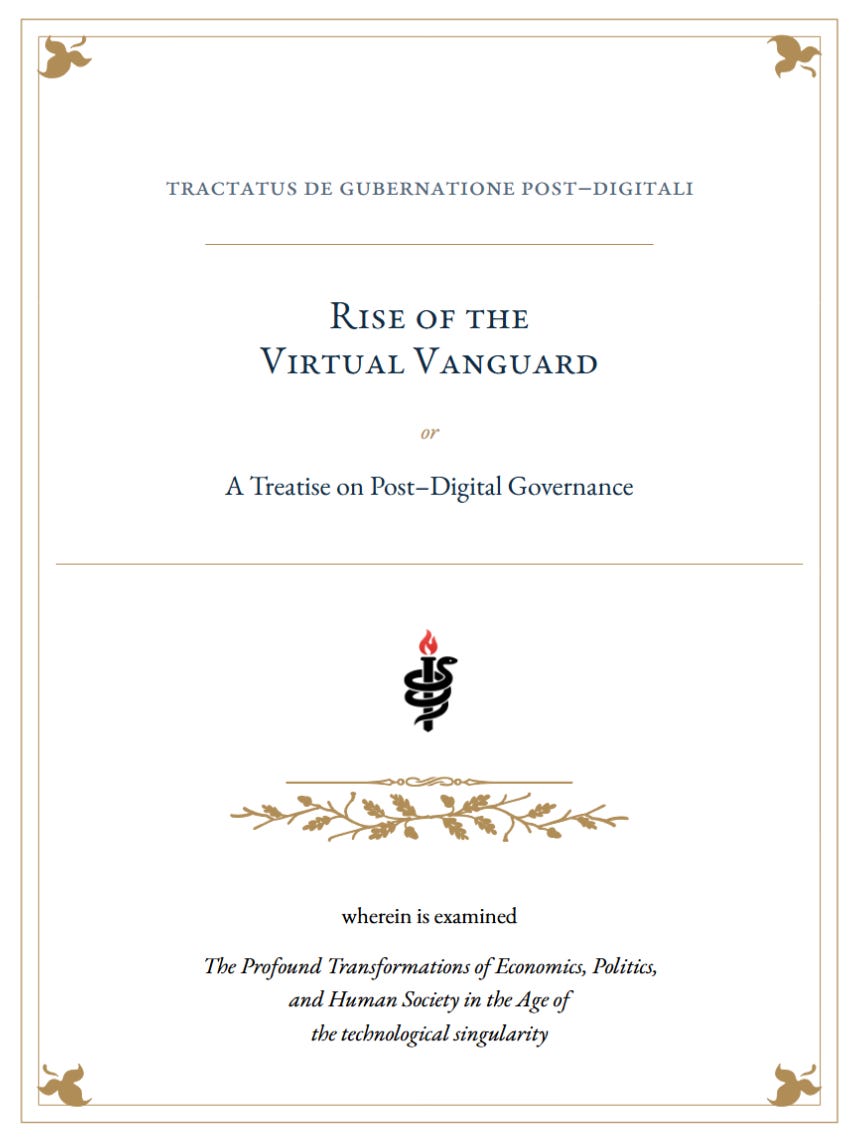
A Note from the Author
What you’re about to read is the first installment of a serialized release from my larger work, Rise of the Virtual Vanguard: A Treatise on Post-Digital Governance. Over the coming weeks, I’ll be publishing selections from the treatise here. each one designed to stand alone while building toward the full argument.
The complete treatise will be available as a book and downloadable PDF for those who want to engage with the work in its entirety. But for now, I’m releasing it piece by piece, partly because long-form writing deserves more than a single scroll, and partly because I want to hear from you as we go.
If this resonates, or if you want more, drop a comment below. Tell me what you’re thinking. Tell me where you disagree. The best ideas are sharpened in conversation, and I’d rather build this audience through dialogue than algorithms.
Let’s begin.
Forward
Predicting or modeling the future economic or political environments of our world is inherently uncertain.
Part of my motivation for writing this is both to lay out the trends myself and others are seeing, as well as bring a level of clarity to the otherwise chaotic world that stands before us.
Much of what you are seeing I wrote over the last three years, during those years I have spent nearly every day, and most nights, reading, arguing, implementing, and working directly in the fields and topics I write about here. I earned a Masters of Science from the University of Edinburgh and recently applied to Harvard University, I have been conduction consulting work for some of the biggest names and building software and governance systems that have both succeeded and failed during the writing of this. I felt it necessary to make many changes since the first edition of this Treatise.
The goal is not to change any of the core axioms but rather give more context (and evidence) to many of the statements I made years ago that still hold true today, and I believe, will continue to hold true for at the very least, the next decade.
I also see a severe gap in today’s literature, a gap that has formed not due to one specific problem but rather the average of a particular set of perspectives found within modern academia.
One particular perspective is the logical fallacy that in order to have anything useful to say on a topic you must have a specific degree, certification or title that supports what you are saying to be of some level of worthiness and thus further write within the formulas of speech that would be expected of “academic writing”.
I argue that this mentality has created Stochastic parrots of us all. This is not to say that peer review, academic rigour, repeatability and the need to be held accountable for your statements is not important but rather much of the academic world has been conducting food reviews on the restaurant menu rather than the food its self.
That is to say we spend so much time on the way we say something rather than the something that is being said. Almost gatekeeping knowledge and statements about said knowledge behind a system that promotes incremental changes to status quo and limiting the ability to jump beyond the confines of the bias of any system of thought.
This is precisely why we are witnessing an inversion of intellectual authority where the most cited and influential research papers increasingly originate not from traditional academic institutions but from commercial laboratories and third party think tanks.
A 2023 analysis published in Scientometrics found that AI papers co-authored by corporate entities receive over three times as many citations as those produced by universities alone. This is not a one off paper, there are many more that focus on this very concept across all genres. Between 2004 and 2018 over 150 AI professors departed North American universities for industry positions, with the trend accelerating such that by 2018 those departing academics accounted for roughly 29 percent of all AI citations produced by their former institutions.
Universities themselves are experiencing what some call a demographic cliff, having seen a 15 percent decline in enrollment between 2010 and 2021 according to the National Center for Education Statistics, with projections suggesting a further 15 percent decline between 2025 and 2029.
Think tanks and corporate laboratories can act with speed to produce policy relevant research that bypasses the very gatekeeping systems I described above while still maintaining enough methodological credibility to be taken seriously by media, government, and the public.
Academic research has been left to conduct, as I said, food reviews on the menu while the actual meals are being prepared and served elsewhere.
The system that was meant to protect rigour has instead created a vacuum, one that commercial interests and advocacy organizations have been more than happy to fill.
Now before you ask “what makes you credible?” and I give some form of justification through my collegiate studies and world travels (of which I promise could be a book in themselves). I’d rather direct you to the seemingly counter-intuitive fact that I have been writing this article in collaboration with various Artificial Intelligence (AI) platforms in an attempt to sift through the massive amount of data and writings out there nowadays (as well as to format this in LaTeX).
In this statement, I can see the immediate rising up of rejection of any of the following writings into a pile of “Ai Slop” by many readers.
If you are one of these readers, I would like to both reassure you that 1. much of this is written by me (typed in this case) and 2. even if the words you are reading now could possibly be generated by an AI (again these ones are not) they are extremely intentional, every single word, comma, and period have been meticulously placed so as to take the many thoughts and ideas of my mind and translate them into a language hopefully others can understand.
In the same way the keyboard, the software the keyboard is sending symbols too, and the medium on which you are reading this (computer screen, paper, hologram) all automate the process that once upon a time used to take pen and paper, Ai tools such as LLMs allow me to automate some of this writing and research process as well.
I must defend the use of AI as a tool and collaborator, and most likely will have to defend it for the many years to come. By using AI and ML (Machine Learning) models such as LLMs to not only explore research for me, but also interpret that data in its own words, I believe it is more than possible for the everyday college student or professor to produce writings and studies that can compete with the best of the best in academics not only from the idea of accuracy but also in critical and predictive thought.
Now all that being said I am still spending hours upon hours reading and studying on my own (and believe everyone should) in order to collaborate and verify the any outputs given to me by any Large Language Model other various Models, but still I think it important to place great weight on the time cut down by using and working with AI Tools on projects like this.
To me the way in which I use AI for writing in economics and politics is the same way mathematicians use calculators to create and solve intense problems.
Now I believe the comparison of modern GenAi to the calculator is actually a very poor one, a concept I dive deeper into later on in my writings here there is still a core idea that is important to understand.
The invention of advanced calculators saved massive amounts of time and allowed even the everyday mathematician to work on more advanced theories and proofs and increase the level of accuracy at the same time.
If you are not using some sort of deep learning software or technology to help your studies, work, writing, or anything else, it’s the same as using the library to answer something that a google search or dive into SAGE/JSTOR could quickly solve.
Let me be clear, it is still very important to read books and know the fundamentals of any field of research, but once you have the groundwork, it makes sense to use the faster and better resource so your time can be spent on advanced topics or critical thinking (dare I say personal passions?).
And even if none of that is convincing enough, I argue that consulting artificial intelligence, particularly Large Language Models (LLMs), for refinement and augmentation of one’s writing bears striking resemblance to seeking insights from peers or editors. After conducting rigorous research and formulating initial drafts, I utilize AI models trained (One-shot RAG if I am being honest) on my own writings.
This allows for meticulous editing, enrichment, and diversification of content from both sides of the creation process. Utilizing technology in this manner is simply a contemporary embodiment of age-old collaborative efforts, only in this case. I am dialoguing with a stochastic parrot of unprecedented sophistication, modernizing and streamlining the editorial process for the current age.
Also, in a paper speaking on the Post-digital world, it is only fitting A.I. plays even a small part in its creation, and honestly, I can see Descartes or Newton looking down on all the academics who use a Keyboard and Mouse rather than Ink and Paper to write so lets just focus on the ideas and statements within this paper and hand me some trust that every word was in fact meticulously chosen.
As a final point I ask one question of those who would defend the current systems of academic gatekeeping. Let us set aside my criticisms for a moment and look at what we, across all disciplines and institutions and even the business world, agree should be taught. What do we place in the hands of freshmen on their first day? What do we assign to MBA candidates and philosophy students and political scientists alike? Overwhelmingly it is the classics. It is Adam Smith and Descartes and Rousseau and Locke and Marx and Machiavelli. It is Plato’s dialogues and Aristotle’s treatises and the Federalist Papers. These are the works we consider foundational, the texts we believe every educated person must grapple with in order to think clearly about the world.
And yet I ask you to consider what would happen if any of these authors submitted their works to a modern peer reviewed journal. The Wealth of Nations contains not a single regression analysis. The Social Contract offers no controlled experiment. Meditations on First Philosophy cites nothing beyond the author’s own capacity to doubt. These texts are, by every metric we now use to determine academic worthiness, entirely opinionated. They are speculative. They are, in the language of modern academia, insufficiently rigorous.
We do not teach Rousseau because every claim he made was empirically verified. We do not read Machiavelli because his sample size was statistically significant. We teach these works because of what they produce in the mind of the reader, because they create new structures of thought and force us to confront questions we did not know we had. The value is not in the accuracy of every word and statement but in the intellectual territory they open for exploration.
The great irony of our present moment is that we have built systems of knowledge production that would have strangled the very works we now consider essential to human understanding before they ever reached the light of day.
Now that ranted on about why I believe what you are about to read is in fact ‘readable’ and at the very least allows for a greater discourse on the topic, let us move into the predictions that myself, academics around the world and even Artificial Intelligence models have, about our future…….
Full paper will be available soon. Comment below if you want more or your thoughts.
Great article, more please!
I think you two could have some incredible synergy https://substack.com/@natesnewsletter